
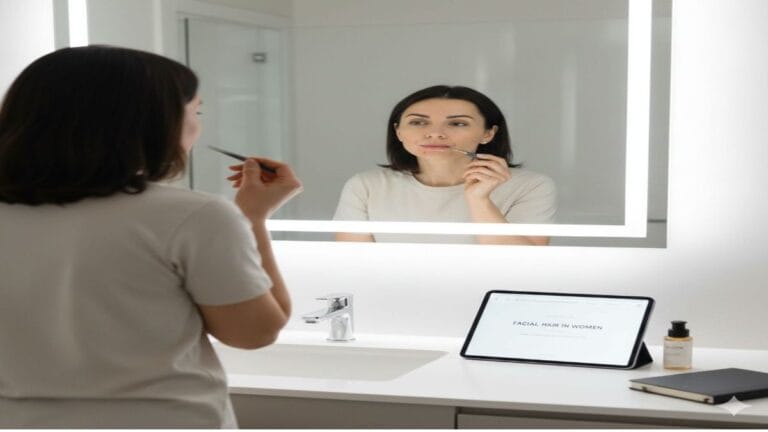
Facial hair in women is not talked about enough and when it is, it’s often surrounded by shame, unrealistic promises, or marketing tricks. This is my real story with hirsutism, what did not work, what actually helped, and what I wish someone had explained to me earlier. If you are dealing with unwanted facial hair and feeling frustrated, confused, or exhausted, I want you to know one thing first: you are not alone, and this is not your fault.
My Real Story With Hirsutism (Facial Hair)
For years, I struggled with facial hair that felt “too male” dark, coarse hair on my chin and jawline. It affected my confidence deeply. I constantly checked mirrors, avoided bright lighting, and felt anxious about people noticing.
Like many women, I tried every home remedy I could find:
- waxing and threading
- turmeric and gram flour pastes
- DIY face masks
- internet “guarantees”
Some helped temporarily. Many did nothing.
Most just made me feel more frustrated.
What finally made a difference was not one magic remedy, but a combined, realistic approach:
- improving my lifestyle from the inside
- using herbal support carefully
- choosing supplements responsibly
- and accepting professional help through laser hair removal
I did not see overnight results.
But over 4–6 months, the manly hair pattern reduced, regrowth slowed, and I felt calmer and more in control. This article is not a miracle claim.
It is my honest experience, supported by medical understanding.
A Quick Reality Check (Very Important)
Before anything else, here is the truth most people don’t explain clearly:
- Hirsutism is a symptom, not a disease
- It is most commonly linked to PCOS, insulin resistance, or hormonal imbalance
- Facial hair does not disappear instantly, even when hormones improve
- Most changes take months, not weeks
My experience may not apply to everyone, because results depend on the underlying cause.
What Actually Helped Me (My 4–6 Month Approach)
Medical Check (Please Don’t Skip This)
Before focusing on remedies, I did basic medical testing:
- hormone levels
- thyroid
- androgen markers
This step matters because facial hair can sometimes signal treatable medical causes.
Knowing the reason behind the hair growth gave me clarity and direction.
Lifestyle Changes (The Foundation)
This was the hardest part but also the most important.
I focused on:
- better sleep
- reducing processed foods and sugar
- daily walking (30 minutes)
- managing stress
This did not remove hair directly.
But it reduced hormonal stress on my body, especially insulin resistance, which plays a big role in facial hair growth for many women with PCOS.
Spearmint Tea (Herbal Support, Not a Miracle)
I drank 1–2 cups of spearmint tea daily for several weeks. I found that drinking two cups of organic spearmint tea daily (brewed for 5–10 minutes) worked best. I didn’t see results until about Week 8.”
From my experience:
- it did not remove hair
- it did help me feel less “hormonally out of balance”
- regrowth felt slightly slower over time
Small medical studies suggest spearmint tea may reduce free testosterone, but it is not a standalone cure.
I avoided it during times it didn’t suit my digestion and would never recommend it during pregnancy.
Supplements (With Medical Awareness)
After discussion with a doctor, I used inositol for metabolic and insulin support.
Important truth:
- supplements support internal balance
- they do not erase existing facial hair
- results vary between individuals
I avoided random supplement stacking and focused only on what made sense for my condition.
Laser Hair Removal (The Fastest Visible Change)
Laser hair removal was the biggest visible turning point for me.
- hair density reduced
- thickness reduced
- regrowth slowed significantly
- the “male-pattern” look softened
Laser did not work alone it worked best because I was also improving my internal health.
Multiple sessions were needed, and maintenance may still be required.
Topical Options (Optional)
I learned about prescription creams like eflornithine that slow hair growth.
These do not remove hair permanently, but they can help when combined with laser or threading.
Myths vs Facts (Please Read This Carefully)
Myth: “Apply this paste and facial hair will disappear”
Fact: Home remedies may slow regrowth slightly, but they cannot permanently remove terminal hair
Myth: “Herbal drinks are useless”
Fact: Some herbs may support hormonal balance, but they work slowly and mildly
Myth: “Fix hormones and hair will fall out immediately”
Fact: Hair follicles follow long growth cycles. Even when hormones improve, visible hair takes months to change
A Practical, Safe Plan You Can Follow
- Start with medical evaluation
- Fix lifestyle basics (sleep, stress, food, movement)
- Use herbal support cautiously (like spearmint tea)
- Consider supplements only if appropriate
- Use cosmetic methods for visible relief (laser, electrolysis, threading)
- Be patient with timelines (3–6 months minimum)
This combination is realistic.
Anything promising instant removal is usually marketing.
Safety Notes (Please Don’t Ignore)
- Herbal remedies can interact with medications
- Supplements are not safe for everyone
- Pregnancy and breastfeeding require extra caution
- Mental health matters facial hair can be emotionally exhausting
If hirsutism affects your confidence or mental well-being, you deserve support.
Frequently Asked Questions
Will spearmint tea remove my facial hair?
No. It may support hormonal balance, but it does not remove existing hair.
How long before I see results?
Internal changes may start in weeks. Visible hair changes usually take 3–6 months.
Is laser hair removal permanent?
Laser provides long-term reduction. Electrolysis is the only method considered fully permanent.
Should I stop medical treatment if I try natural methods?
No. Natural approaches are supportive, not replacements.
Final Words (From Me to You)
Living with facial hair as a woman can feel isolating and unfair. I know the frustration because I lived it. What finally helped me was stopping the search for “miracle cures” and choosing a balanced, honest approach: inner healing + realistic external treatment.
If you are on this journey, please be kind to yourself. Change is possible, but it takes time, consistency, and the truth. You are not defined by your symptoms, and you don’t have to do this alone.
Medical Disclaimer
This article is for educational purposes only and does not replace professional medical advice. Always consult a qualified healthcare provider before starting or stopping any treatment.


Pingback: Why Is My Hair Falling Out? (3 Reasons It’s Not Just Your Shampoo)
Pingback: 7 Early PCOS Symptoms in Women: The Essential Guide to Warning Signs